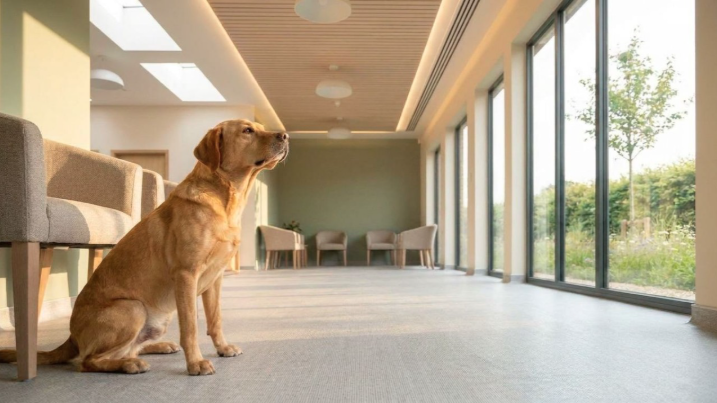
Golden Labrador sitting in a bright, modern veterinary waiting area
A practice manager once said something to me that I’ve never forgotten. We were walking through her building, and she stopped by the door to the kennels, wrinkled her nose and said, “You stop noticing it after about twenty minutes. That’s what worries me.”
She was right to be worried. The nose adapts quickly. The body doesn’t always. One of her nurses had been getting headaches every few weeks, and nobody had thought to connect them to the building.
We spend a great deal of time in veterinary design talking about what a building looks like and, more recently, what it sounds like. We talk far less about what it smells like and what’s actually in the air people breathe for ten or twelve hours a day. Yet in my experience, after twenty-five years of walking practices and hospitals, air quality is one of the most common hidden reasons a building feels tiring to work in.
At the end of this article, I’ll tell you about a small study we’re starting that asks a question I don’t think the veterinary sector has properly asked yet. Can a nervous cat smell the dog that was in the consult room before it, and does it matter?
The Air in a Veterinary Building Is Working Hard
A veterinary practice is not an office. The air is carrying a lot. There are animal odours from wards and kennels. There are disinfectants and cleaning chemicals, often used in quantity and several times a day. There is dust and heat from equipment, autoclaves, dryers and washing machines. There is moisture, lots of it, from hosing down kennels and drying wet dogs. There are aerosols from dental procedures, and airborne pathogens. Let’s not think too hard about what could be in the air in an isolation ward.
That combination does more than make a building smell. It contributes to headaches, fatigue, irritated eyes and throats, and the low-level, heavy feeling at the end of a shift that people often put down to the workload. For team members with asthma, allergies or sensory sensitivities, it can be the difference between a manageable day and a miserable one.
Here’s a question I can’t yet answer. When we talk about sensory overload, we talk about noise and light. We almost never talk about smell. Yet for some people, particularly those who are neurodivergent or live with migraines, a strong or lingering smell isn’t just unpleasant. It can be the thing that makes a long shift feel impossible. I suspect it’s far more common in our practices than anyone has recognised.
And the animals feel it too. A dog’s sense of smell is many times more sensitive than ours. A ward that holds on to the scent of stress, illness and strong cleaning products is not a restful place to recover.
Three Questions I Always Ask
When I’m briefed on a refurbishment, I ask three simple questions about the air.
First, where does the bad air go? In many older practices, the honest answer is “out of the nearest window, if someone remembers to open it”. Extraction is often a bathroom-type fan in the kennel room ceiling, put in by an electrician fifteen years ago, not cleaned since, and about as good at moving air as an asthmatic cat.
Second, where does the fresh air come from, and is it warm? If fresh air arrives as a cold draught, people close the window and switch the extract off. I’ve lost count of the number of kennel extract fans I’ve found switched off at the isolator because “it was freezing in here in January”.
Third, which way is the air moving? Air should move from clean to dirty, from offices and consult rooms towards wards, isolation and the dirty end of prep, and then out. In a surprising number of buildings, it does the opposite, and the smell of the kennels drifts happily into reception every time the door opens.
Fresh Air Without Throwing the Heat Away
Every practice owner feels the same tension. More ventilation means healthier air, but it also means heat going out of the building, and energy bills have not been kind to anyone lately. A 24-hour hospital heating and ventilating its wards through a winter night is a serious cost.
The answer, in most new builds and many refurbishments, is mechanical ventilation with heat recovery. Stale air is extracted, fresh air is supplied, and the two pass each other through a heat exchanger, so the warmth in the outgoing air pre-heats the incoming air. You get the fresh air without paying to heat it from scratch. It pairs well with heat pumps, which I’ll be writing about later in this series.
It does need careful design in a veterinary building. Contaminated areas such as isolation and some lab spaces need their own extract and shouldn’t share a heat exchanger with clean areas. The system needs zoning, so you’re not ventilating a set of empty consult rooms at three in the morning to keep the ward fresh. And it needs to be quiet, because a noisy ventilation system just swaps one sensory problem for another.
Maintenance: The Bit That Decides Whether Any of It Works
I’ll be honest. I’ve seen excellent ventilation systems fail within a few years for one reason only. Nobody changed or cleaned the filters.
Ventilation is a living system. Filters clog with dander and hair far faster in a veterinary building than in an office. Ductwork near kennels and grooming areas collects debris. Fans wear. If the plant is in a loft hatch above the ward that needs a ladder and a contractor to reach, there’s a good chance it won’t be maintained, and within a year or two the air will be no better than it was before you spent the money.
So we design for maintenance from day one. The plant is located where it can be reached safely, ideally from outside the clinical areas. Filters can be changed by a trained member of staff without dismantling a ceiling. There are access panels in the ductwork, and a planned maintenance schedule is handed over with the building, written in plain English, with a named person responsible. It isn’t glamorous, but it’s the difference between a system that works for twenty years and one that’s quietly switched off by the second winter.
Maintenance is a shared job, though, and the best-run practices treat it that way. I had one project where the clinical team told me the ventilation simply wasn’t changing the air, and had already called the maintenance team out, convinced the system didn’t work. I spoke with the company that had installed the system four years earlier, and they went to take a look. They rang me back to say the isolator above the ceiling had been switched off. Yes, that isolator again. Given the amount of dust and debris in the filters, the system hadn’t been cleaned since the day it was installed.
As I say to people, you wouldn’t spend money on a new car and then not service it for four years, would you?
Start With the Source
Ventilation deals with what’s in the air, but the best design reduces what gets there in the first place. That means good cleaning regimes in kennel areas, so floors are dried quickly and don’t stay damp and smelly. It means laundry and drying in their own extracted room rather than off the prep area. It means cleaning products chosen with the team, so you’re using effective, lower-odour products in the right dilution, ideally dosed automatically. And it means low-emission paints, adhesives and finishes, so a new building doesn’t spend its first year off-gassing into the people working in it.
There’s a sustainability angle here as well. Planting around air intakes, rather than locating them next to the car park or the bins, gives you better air to begin with. Trees and hedging on the boundary help filter dust from a busy road. It’s a small move, but it’s the kind of thinking that makes the site itself part of the solution.
The Day the Smell Went
That practice manager with the twenty-minute nose? We refurbished her kennel ward, with the correct extract, heat recovery and a properly extracted laundry. On the first Monday after handover, I rang her and asked how the ward smelt. “I’ve just walked in,” she said. “I can’t smell anything.”
And the nurse with the headaches? A few months later she told her manager she couldn’t remember the last one.
One Step Further
Regular readers will know that I can be a curious soul when it comes to making the building the very best it can be for patients, clients and clinical teams. It struck me that animals have a far more acute sense of smell than we do. If we think parts of the building are “whiffy”, to say the least, what on earth does the animal think?
So I’ve teamed up with a mechanical ventilation company and a sensory scent company to test whether we can genuinely improve the air quality in parts of a practice or hospital. Our first locations are the wards, consult rooms and waiting areas.
What I want to find out is this. If a dog has been in a consult room and the next patient is a nervous cat, does the smell of the dog heighten the cat’s anxiety? And the same the other way round. If it does, can we neutralise that smell before the next patient comes in, rather than waiting for the ventilation to clear it? To be clear, anything we use will be tested to make sure it’s safe for animals, because some scents and essential oils can be harmful to cats, and the last thing a nervous cat needs is something that irritates its airways.
We’re also looking at the comfort rooms where pets are put to sleep, which I wrote about in [The Room Where It Ends], and at the waiting areas. Systems like this are already used in other sectors, such as human healthcare and hospitality, so why not in veterinary? I’ll keep you posted on what we find.
It isn’t only about the patients. Alongside the animal side of the study, I’d really like to hear from vets, nurses and receptionists about how smell affects them over a shift.
If the Air in Your Building Is on Your Mind
If there’s anything about your building you’d like a hand with, I’m always happy to help. And if now isn’t the right time, I’ll quite understand. You can reach me at peter.hall@agrarian-uk.com.

Written By
Peter Hall, Managing Director
Peter Hall specialises in veterinary facility design and project delivery, working on referral hospitals, multi-site practices and clinical developments. For more than twenty years he has designed, refurbished and audited hundreds of veterinary buildings.
Find Peter on LinkedIn